
Filter by Type
Filter by Category
Filter by Size
Filter by Year
Exhibitions

Herbert Barnett and the Cubist Still Life
Press Release:
Herbert Barnett was an American artist whose life and work was closely tied to New England, and yet, his distinctive style of painting drew heavily upon the artistic innovations of Cubism. Though portraits, landscapes, and genre scenes are all among the artist’s oeuvre, still lifes were a thematic constant throughout Barnett’s career, providing an endless study of Cubist forms and angles. This exhibition is a survey of the artist’s continual exploration of the still life over a 30 year period.
Born in Cranston, Rhode Island, Barnett grew up in Providence. While still in high school, he began to study painting at the Rhode Island School of Design. From 1927-31, he studied at the Boston Museum School and soon acquired a reputation for technical proficiency. At seventeen, he had his first one-man show at the Grace Horne Gallery in Boston and was already teaching private classes. After art school, where he won the Paige Travelling Fellowship, Barnett spent three years traveling and studying in Europe. As he assimilated what he had learned in Europe and absorbed the influence of the older generations of American painters, notably Marsden Hartley, Walt Kuhn, and Edward Hopper, Barnett's style evolved rapidly, and by 1939, his painting possessed characteristics that would remain relatively constant in his further development.
Barnett’s working method is best exemplified by his still life paintings which frequently feature fruit, bottles, and other everyday objects balanced on tilted, topsy-turvy tabletops. He began each work by quickly drawing with the brush to capture the basic contours of his subject. Next, he made a tonal underpainting in oil wash to indicate the most prominent volumes as areas of light and shadow. The painted surface consists of a pattern of discreet, rectangular brushstrokes. Barnett's emphasis on structure clearly reflects his admiration for Cezanne and the Cubists.
Driftwood, bones, seashells, and art materials are among the subjects that feature in Barnett’s still life paintings. Such items allowed Barnett to explore planarity and rhythm in untraditional objects. His Cubist manipulation of the still life afforded experimentation in composition, creating bold and expressive paintings with inventive takes on form and perspective.
Awarded several distinguished positions at prestigious museum schools and honored with exhibitions around the country, Barnett was widely regarded as a painter of extraordinary ability and a virtuoso draftsman. Herbert Barnett and the Cubist Still Life focuses on one genre within the artist’s long, respected career through which both his technical skill and Cubist sensibilities are evident to dramatic and striking effect.
Included Works


La Ville Lumière: Prints of Paris
Press Release:
For centuries, the city of Paris - known as "La Ville Lumière", or "The City of Light" - has electrified the abounding curiosities of artists and intellectuals worldwide. From Childs Gallery's unique collection of works on paper, this exhibition is a tour of the Parisian Scene from the 19th century through today.
Paris is referred to as the City of Light for a number of reasons: its leading role in the Age of Enlightenment, its early adoption of gas street lighting, and its famed open boulevards and urban design. In 1853, at the direction of French emperor Louis Napoleon, Baron Georges-Eugène Haussmann embarked on a project of urban renewal and modernization, transforming the old, cramped medieval city into a “City of Light”. The result was the open light-filled city we know today: a Paris characterized by wide boulevards, homogenous architectural blocks, and open public spaces.
By the 19th century, the Salons and Academies of Paris were the Mecca of art students and the city itself the center of the art world. The radiance of Paris drew countless artists from across the globe, finding in its vibrant mood a climate favorable to their art. The dazzling city itself was often the subject of such works, captured by the artist’s brush, pen, and burin. Each artist had their own vision and fantasy of Paris: its beauty, its vibrancy and light, its myriad attractions. The combination of old and new buildings, the splendors of boulevards, the profusion of cafes and grand theaters, and cherished landmarks such as the Eiffel Tower and Notre Dame Cathedral, all exerted a spell-like effect upon those who visited.
La Ville Lumière features artists’ interpretations of the Parisian cityscape from the 19th century to today. Focused on printmaking, the exhibition showcases a range of print media from varied artistic styles and movements.
Included Works


![Print By David Young Cameron: Hôtel De Sens [paris] At Childs Gallery](https://childsgallery.com/wp-content/uploads/david_young_cameron_htel_de_sens_paris_p2356-07ra_childs_gallery-750x750.webp)
![Print by Joseph Margulies: Along Latin Quarters, Paris [2] or Market at Left Bank, Pari, represented by Childs Gallery](https://childsgallery.com/wp-content/uploads/joseph_margulies_along_latin_quarters__paris__2_p2050-465-05_childs_gallery-250x250.webp)
![Drawing By Henry M. O'connor: [barge On Siene Near Notre Dame, Paris] At Childs Gallery](https://childsgallery.com/wp-content/uploads/henry_m._oconnor_barge_on_siene_near_notre_dame_paris_cgl56513-79a_childs_gallery-750x750.webp)
![Print By Jean Michel Mathieux Marie: Quai Des Célestins [celestin Quay] At Childs Gallery](https://childsgallery.com/wp-content/uploads/jean_michel_mathieux-marie_quai_des_clestins_celestin_quay_bb1092-03_childs_gallery-750x750.webp)
![By Henry M. O'connor: [les Deux Magots, Paris] At Childs Gallery](https://childsgallery.com/wp-content/uploads/henry_m._oconnor_les_deux_magots_paris_cgl56513-78a_childs_gallery-750x750.webp)
![Print By Albert Decaris: [tuileries Gardens, Paris] At Childs Gallery](https://childsgallery.com/wp-content/uploads/albert_decaris_tuileries_gardens_paris_03-09-03_childs_gallery-750x750.webp)
![Print By Henry M. O'connor: [docked Boats On The Siene, Paris] At Childs Gallery](https://childsgallery.com/wp-content/uploads/henry_m._oconnor_docked_boats_on_the_siene_paris_cgl56513-56a_childs_gallery-750x750.webp)
![By Henry M. O'connor: [two Fisherman On The Siene, Paris] At Childs Gallery](https://childsgallery.com/wp-content/uploads/henry_m._oconnor_two_fisherman_on_the_siene_paris_cgl56513-67a_childs_gallery-750x750.webp)
![By Henry M. O'connor: Paris, River Siene [france] At Childs Gallery](https://childsgallery.com/wp-content/uploads/henry_m._oconnor_paris_river_siene_france_p2348-36_childs_gallery-750x750.webp)

The Age of Etching: Old Master Prints, 1600-1800 – Online Exhibition
Press Release:
Our new online-only exhibition, The Age of Etching: Old Master Prints, 1600 - 1800, is a nod to the Metropolitan Museum of Art's upcoming exhibition, The Renaissance of Etching, opening October 23, 2019. Our show explores the etching media during the Renaissance through works by artists including Rembrandt Harmensz van Rijn, Jacques Callot, Giovanni Battista Tiepolo, Giovanni Castiglione, Veneziano, Francisco José de Goya y Lucientes, and others pulled from the Childs Gallery Print Department holdings.
The exhibition is on our website through November 9, 2019.
Included Works


![Print by Jacques Callot: Le Combat Naval [The Naval Combat], represented by Childs Gallery](https://childsgallery.com/wp-content/uploads/jacques_callot_le_combat_naval__the_naval_com_bb1045-01_childs_gallery-500x500.webp)
![Print by Jacques Callot: L'Embarquement des Marchandises [The Embarkation of Goods], represented by Childs Gallery](https://childsgallery.com/wp-content/uploads/jacques_callot_lembarquement_des_marchandise_bb1045-02_childs_gallery-1-500x500.webp)

![Print By Giovanni Andrea Podesta: Bacchus Meeting Ariadne On Naxos [after Titian, Italian (1488 1576) For Alfonso, The First Duke Of Ferrara] At Childs Gallery](https://childsgallery.com/wp-content/uploads/giovanni_andrea_podesta_bacchus_meeting_ariadne_on_naxos_after_titian_italian_1488-1576_for_alfonso_the_first_duke_of_ferrara_bb5502-06_childs_gallery-750x750.webp)


Sean Flood: Subterranean/Surface
Press Release:
BOSTON, MA – In his third solo exhibition with Childs Gallery, Sean Flood explores the New York Transit system, connecting his familiar cityscapes to a frenzied, labyrinthine world below. In prints and paintings, Flood observes the subway and its structures, uniting and confusing space, while paying close attention to the passengers and their interactions. By layering reflections and using mark making to interpret the sound and movement that comes with the hustle of commuting, Flood introduces the viewer to a new perspective of this underground world.
Flood’s artistic methods have always cleverly mimicked the building process itself, revealing structural layers of architecture, ink, and paint through strong, deliberate strokes. His technique transfers seamlessly underground in his new work, modelling the subway system through its distinctive shapes and forms.
Much as Flood’s unique mark making animates his cities with urban buzz, his subways epitomize the hurried energy of public transit. But here underground, Flood also has concerns beyond simply capturing the start-stop motions of a train car. He details human actions and interactions within these enclosed spaces, documenting feelings, moods, and behaviors instantly recognizable to an audience. Flood sets up these scenes through subway doors and windows, expertly framing his passengers in layers which separate them from the viewer.
Flood has not entirely left behind his skyscrapers for the subway. Subterranean/Surface is rounded out with cityscapes of Boston and New York (both home bases for the artist), complimenting his new underground venture with recognizable skylines and streets. New scenes include Boston’s soaring One Dalton tower, Manhattan streets, and the artist’s own studio interior. In both his above and below ground images, Flood’s paintings and prints continue to inform one another through artistic dialogue. His lively mark making in oil echoes the striking lines of monotype and etching, and vice versa. Whatever the media, each piece is built up layer by layer, exposing the constructive framework of Flood’s process with a juxtaposing sense of deliberate spontaneity.
Through subways and cities, Flood paints a vivid ode to urban life both below and above ground, perfectly encapsulating a bustling metropolitan atmosphere. Subterranean/Surface journeys between these worlds, twisting through subway tunnels and dizzyingly crowded streets that sing with the cacophony of city living.
An opening reception for the exhibition will be held Thursday, September 5, 6-8pm. The artist will be in attendance.


Radical Compositions: AbEx Prints and Paintings
Press Release:
BOSTON, MA - Developed in New York in the 1940s, Abstract Expressionism was the first uniquely American art movement to garner international acclaim and influence. Featuring prints and paintings by both first- and second-generation Abstract Expressionists, Radical Compositions explores the evolution of the movement from its east coast emergence to dominance of the American and international art scene, ultimately shifting the epicenter of the art world from Paris to New York.
Pulling from Childs Gallery’s vast inventory, Radical Compositions includes artwork by some of Abstract Expressionism’s earliest proponents, and illustrates different evolving styles within the movement, from action painting, to color field, to interpretations by international groups such as COBRA.
The exhibition features work by Lee Krasner, Henry Botkin, Alexander Calder, Robert Rauschenberg, Robert S. Neuman, Louise Nevelson, and Ruth Eckstein, among others. Radical Compositions: AbEx Prints and Paintings is on view in the Childs Gallery Print Department, August 22 through November 3, 2019.
![Print by Karel Appel: [Abstract Composition with Face], represented by Childs Gallery](https://childsgallery.com/wp-content/uploads/karel_appel__abstract_composition_with_fac_15-15-02_childs_gallery-1-500x500.webp)


![Mixed Media By Henry Botkin: [untitled] At Childs Gallery](https://childsgallery.com/wp-content/uploads/henry_botkin_untitled_cgl39310-0071r_childs_gallery-1-750x750.webp)


![By Henry Botkin: [untitled Abstract In Yellow And Pink] At Childs Gallery](https://childsgallery.com/wp-content/uploads/henry_botkin_untitled_abstract_in_yellow_and_pink_bb5849-05_childs_gallery-750x750.webp)


Centennial: The Woodstock Artists Association, 1919-2019 – Online Exhibition
Press Release:
Founded by John F. Carlson, Frank Swift Chase, Andrew Dasburg, Carl Eric Lindin, and Henry Lee Mc Fee, the Woodstock Artists Association and Museum is one of the oldest continuing artist colonies, serving as a cultural center in the village of Woodstock. Since its opening the organization has provided exhibition space to both visiting artists and those who make the area their home. Throughout its long history, the WAAM has been essential in the creation and dissemination of some of the most important art movements of the twentieth century, including Modernism and the American Scene.
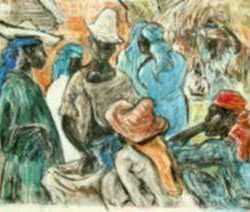
Featuring work by artists including Milton Avery, Sally Michel, Doris Lee, Rockwell Kent, Marion Greenwood, Leon Kroll, Peggy Bacon, George Bellows, and more, Centennial: The Woodstock Artists Association, 1919 - 2019 is a fascinating journey through one of the most successful art colonies in the United States.
Included Works


![Painting by Alexander Brook: [Nude with Rose], represented by Childs Gallery](https://childsgallery.com/wp-content/uploads/alexander_brook__nude_with_rose__87-48-15_childs_gallery-250x250.webp)


![Drawing by Adolf Dehn: Night in East Waterville [Minnesota], represented by Childs Gallery](https://childsgallery.com/wp-content/uploads/adolf_dehn_night_in_east_waterville__minn_cgl55223_childs_gallery-1-250x250.webp)




![Drawing by Alexander Brook: [Nude on Steps], represented by Childs Gallery](https://childsgallery.com/wp-content/uploads/alexander_brook__nude_on_steps__cgl27194-267_childs_gallery-250x250.webp)

![Print by Adolf Dehn: Snow Mountain or Lake in the Mountains [probably Colorado], represented by Childs Gallery](https://childsgallery.com/wp-content/uploads/adolf_dehn_snow_mountain_or_lake_in_the_m_p3073-18r_childs_gallery-250x250.webp)


Lee Essex Doyle: Chimera
Press Release:
Influenced by the artist’s extensive travels through India, Africa, and Europe, Lee Essex Doyle’s miniature jewel-like paintings capture fleeting glimpses of the world. Through mastery of color and rhythm, she expertly depicts landscapes and interiors layered with patterns, textures, and vibrant hues. Essex Doyle’s latest Chimera series reveals her remarkable ability to encapsulate the very essence of a place, whether it be the cerulean domes of Santorini or the lace-like marble of the Taj Mahal.
As an avid traveler, Essex Doyle finds inspiration in the art and architecture of each new location and culture she encounters. Architectural elements – arcades, screens, domes, minarets – combine with ornate pattern and vibrant color to give an authentic sense of place.
The artist’s travels are dedicated to gathering material for her work through photographs, site drawings, and visual observation. Back home in her studio, she pieces these together with her own memories and impressions of a place. For the artist, “A finished painting is the act of fixing in time an impression of millions of feelings, thoughts, images, and longing and like all memories there are so many versions that are true.”
The blending of imagery and pattern, memory and record, ties perfectly into the series title, Chimera. In mythology, the Chimera was a fire-breathing amalgamative monster with the body of a lion, a goat’s head protruding from its back, and a serpent for a tail. In modern usage, a chimera can also refer to either a biological organism composed of at least two genetically different kinds of tissue, or a wild and unrealistic dream or idea. Essex Doyle’s combining of architecture, decoration, memories, and visual records create pictorial chimeras: hybrids of color, pattern, and location. They are illusory images of real-world places; whimsical scenes crafted within the mind of the artist taken from various sources.
However fanciful the artist’s gem-like paintings may be, they are grounded in reality, based upon places to which she has traveled and the audience may hope to visit. Even the intricate overlaying patterns adorning each work reference textiles, stonework, and other architectural elements associated with each location. Essex Doyle enlivens her paintings with the sense memory of every artisan responsible in creating the extraordinary villages, temples, palaces, and cloisters she captures. Combining their artistry with her own, Essex Doyle further heightens the chimera effect of her worldly paintings.
Colorful and dreamlike, the work of Lee Essex Doyle offers glimpses of far off locales that feel iconic yet tangible. Even if one has never been to the Greek Isles, India, or wherever the artist has found herself, the locations are instantly recognizable, not just through architecture alone, but also the feeling Essex Doyle imparts upon her work. The hues, the patterns, the buildings all harmonize into a sense of location and presence, palpable whether one is personally familiar with the place or not. In her miniature paintings, the artist creates miniature worlds, intimately felt through thoughtfully layered compositions that capture the elements which make a destination memorable.
The artist will be present at the opening reception, held Thursday, July 11, from 6 to 8pm.
Included Works


Out-Spoken: Fifty Years of Pride
Press Release:
This exhibition commemorates the fiftieth anniversary of the Stonewall Riots, as well as celebrating Pride Month. Featuring historic and contemporary artists from the LGBTQ community, Out-Spoken: Fifty Years of Pride examines queer identity through paintings, prints, photographs, and drawings.


Don Joint: Narcissus
Press Release:
In western theory, the myth of Narcissus, a beautiful youth who falls in love with his own reflection, carries overt tones of homoeroticism as an essentially queer narrative in which a man experiences same sex attraction. In this exhibition, multimedia artist Don Joint explores the sensual gaze central to the Narcissus myth through his various series of works including collages, bottles, dinnerware, and other found ephemera. On display are nubile young men brashly arranged yet unaware they are the object of desiring eyes, serving as the reflection to the audience’s lustful Narcissus.
In the most widely known versions of Narcissus’ tale, the Boeotian hunter spurns the advances of his would-be lovers, earning the enmity of the gods. In retribution, Narcissus is lured to a pool where he is besotted by his reflection; upon realizing his affections will never be returned, he wastes away until only a namesake flower remains. The story gives us our modern term narcissism, encompassing extreme vanity, egotism, and megalomania, but it is also a tale of both invitation and rejection: beauty so enticing that it invites the viewer’s gaze yet rejects it at the same time.
Don Joint’s works enjoy this same duality. His beautiful models, mostly photographed by the artist himself, beg the attention of an audience. Unapologetically posed to showcase their comeliness, they often meet the viewer’s eyes with come-hither looks. But Joint has removed his models from any tactile interaction with their admirers. Placed in bottles, on plates, and patchwork collages, they reject their adoration, eliciting a passion that cannot be reciprocated. Like a stationary reflection, Joint has fixed his Narcissi in time by positioning them within the confines of artistic assemblages.
The artist’s various series each have cheeky names including Boys in a Bottle, Dirty Dishes, and Whatnots that give a clever nod towards the bold nature of the work. With each individual piece, Joint presents a fantasy of idealism, attractive and hedonistic youths whose beauty will never fade, à la Oscar Wilde’s Dorian Gray. The Gray character, of course, is influenced by the Narcissus tale, and his story carries similar nuances of homoeroticism. Joint pointedly taps into the idea of a queer gaze throughout his work while asking the viewer to see as Narcissus saw, feel as he felt. Taking in works like Boys in a Bottle: Poison, it is not hard to imagine the startling moments when attraction becomes desire becomes obsession. Pieces such as Whatnots: Three of Me and Dirty Dishes VIII also reflect upon the oft cited but woefully misinformed notion that same-sex desire is an inherently narcissistic form of attraction. Joint gleefully and expertly uses Narcissus as a framework with which to explore all these ideas; to him, the myth is a fruitful playground of alluring men through which one can navel-gaze upon both self and sexuality.
The exhibition is held to commemorate the fiftieth anniversary of the Stonewall riots and will take place during Pride Month. A selection of artwork by other LGBTQ artists including Paul Cadmus, George Platt Lynes, and Emily Lombardo will also be on display. A reception and Pride Brunch will be held June 8 from 11-2pm. Childs Gallery is located just a short walk away from Copley Square, the start of the Boston Pride Parade.
Included Works


![Collage By Don Joint: [small Collage] At Childs Gallery](https://childsgallery.com/wp-content/uploads/don_joint_small_collage_16-12-52f_childs_gallery-750x750.webp)


Raphaël Jaimes-Branger: Monumental, An Homage to Louis Daguerre
Press Release:
Since discovering daguerreotypes in a dusty attic in his childhood home, Raphaël Jaimes-Branger has been fascinated with the early photographic method. Their silvery surfaces captivated his imagination, leading to an adulthood search to replicate the daguerreotype’s physical properties without the use of harmful chemicals.
Daguerreotypes, the first publicly available form of photography, were developed by French artist Louis Daguerre in 1839. The process involved a highly polished silver-plated sheet of copper, treated with a light-sensitive substance that would be exposed to light, then developed with mercury fumes, and finally sealed within an enclosure to protect its delicate surface.
In this exhibition, Jaimes-Branger pays tribute to this process via a technique of his own invention, without the possible fatal consequences of mercury exposure. Through a process the artist dubs “xylotype,” an image is transferred using xylol onto an acrylic sheet that has been églomisé with silver leaf. The resulting image mimics the look of an early daguerreotype. Jaimes-Branger further heightens the effect by mounting the xylotype in a double frame with hand embossed velvet on the left panel and the image on the right, a structure reminiscent of those originally used to house fragile daguerreotypes.
Jaimes-Branger’s choice of subject matter, art and architecture, reflects his desire to indulge in beauty for beauty’s sake as a reprieve from today’s tumultuous political climate. For inspiration, he looks both at home and abroad. Familiar landmarks include Boston’s Old South Church and the Emancipation Memorial in Park Square. The exterior statues of the Palais Garnier, Paris’ famed opera house, are also treated to the artist’s silvery ghostly rendering. Each image is paired with a panel of hand embossed velvet, distressed just enough as to complete the illusion of a time-worn treasure. The overall effect of looking upon Jaimes-Branger’s works is that of remembering; his images seemingly conjure memories of beautiful places that feel foggy or half-forgotten. Though contemporary, innovative pieces, they read as relics from another era.
Jaimes-Branger’s artwork basks in the grace of public art and monuments, works created to embellish urban areas and enhance the quality of daily life for everyday citizens, while also embracing the sentimentality of photographs. By bridging photography, an early socially-equalizing art, and public works intended to uplift the common man, Monumental, An Homage to Louis Daguerre celebrates beauty that is accessible to us all.
The artist will be present at the opening reception, held Wednesday, May 22, from 6 to 8pm.


![Print By Henry M. O'connor: [docked Boats On The Siene, Paris] At Childs Gallery](https://childsgallery.com/wp-content/uploads/henry_m._oconnor_docked_boats_on_the_siene_paris_cgl56513-56a_childs_gallery.webp)