
Filter by Type
Filter by Category
Filter by Size
Filter by Year
Exhibitions

Hello Sailor!
Press Release:
The visage of the able-bodied mariner is prevalent throughout art history canon, from ancient reliefs of naval warfare to modern propaganda posters. Our contemporary image of the uniformed sailor becomes more ubiquitous from the 18th century onwards with dashing portraits of sea captains, handsome wartime heroes, and cavorting seamen on shore leave. Hello Sailor! celebrates these many iterations of mariner imagery, across various media including prints, paintings, photography, and sculpture. Works in the exhibition span from the early 19th century to the present, capturing the evolving sailor imagery of the past two hundred years.
Highlights in the exhibition will include a 1930 color woodcut by German artist Erich Heckel depicting a quartet of sailors theatrically dancing at port, an 1805 painting featuring a handsomely attired British Naval Lieutenant, Bernard Brussel-Smith's stark black and white prints of rakish seamen in seedy bars, Dudley Vaill Talcott's modernist sculptural interpretations of rugged Norwegian fisherman, and 20th century beefcake photographs with models cheekily festooned in nautical attire.
Hello Sailor! is on view in our upstairs gallery February 14 through April 6, 2025.
Included Works


![Drawing By Rockwell Kent: [the Lookout, Related Studies] At Childs Gallery](https://childsgallery.com/wp-content/uploads/rockwell_kent_the_lookout_related_studies_08-35-04_childs_gallery-750x750.webp)


![Drawing by Dudley Vaill Talcott: [Sailor and Woman Embracing], available at Childs Gallery, Boston](https://childsgallery.com/wp-content/uploads/dudley-vaill-talcott_sailor-and-woman-embracing_17-20-03r_childs_gallery_47857-750x750.webp)


![Watercolor by Bryson Burroughs: [Sailboat on Open Water], available at Childs Gallery, Boston](https://childsgallery.com/wp-content/uploads/bryson-burroughs_sailboat-on-open-water_cgl29216-238_childs_gallery_47864-750x750.webp)

![Drawing by Jane Peterson: [Man and Sailor Dining], available at Childs Gallery, Boston](https://childsgallery.com/wp-content/uploads/jane-peterson_man-and-sailor-dining_-cgl54384-22_childs_gallery_47880-750x750.webp)
![Photograph by Alonzo Hanagan (Lon of New York): [Tommy Hume, Tattooed Sailor], available at Childs Gallery, Boston](https://childsgallery.com/wp-content/uploads/alonzo-hanagan-lon-of-new-york_tommy-hume-tattooed-sailor_21-24-047_childs_gallery-750x750.webp)
![Photograph by Tom Nicholl (Scott of London): [Unidentified Model as a Sailor], available at Childs Gallery, Boston](https://childsgallery.com/wp-content/uploads/tom-nicholl-scott-of-london_unidentified-model-as-a-sailor_21-24-023_childs_gallery-750x750.webp)


![Photograph by Bob Mizer: [Model dressed as sailor 1], available at Childs Gallery, Boston](https://childsgallery.com/wp-content/uploads/bob-mizer_model-dressed-as-sailor-1_23-23-12_childs_gallery_47890-750x750.webp)


Making Waves II: Resa Blatman, Joan Hall, & Karen Lee Sobol
Press Release:
In the spring of 2020, Childs Gallery announced the opening of Making Waves, an exhibition featuring the work of Resa Blatman, Joan Hall, and Karen Lee Sobol, three artists using their work to create art that addresses humankind's relationship to the ocean. Just as the exhibition was set to debut, the world was shut down due to the Covid-19 pandemic, and subsequently, Making Waves was only ever glimpsed on the Childs Gallery website, YouTube videos, or through select appointments.
Now, nearly five years later, Making Waves II reimagines the original exhibition with new artwork from Blatman, Hall, and Sobol, alongside select pieces from the 2020 show. A dynamic staging of multimedia work with powerful messaging, Making Waves II advocates for greater awareness of our climate crisis in the hopes of engendering ideas for change.
As the largest habitat on our planet, the Earth's oceans are vast ecosystems of which only a small fraction has been explored. Today, our oceans are greatly endangered by human activity, and recent studies have found that approximately 8 million metric tons of plastic enter the ocean on an annual basis. As this crisis escalates, climate change art bridges the scientific and visual, making hard data more accessible through an emotional response to art. By helping us process this information, climate change art seeks to affect meaningful changes between humans and their environment.
Resa Blatman's paintings consider humankind's place within a vast universe and our ultimate insignificance, versus the quiet strength and influence of tiny things. For several years her work has centered around the shifting climate and catastrophes caused by an overheating planet, juxtaposing the image of a wounded Earth with the resilience of seemingly insignificant plants and animals. These flora and fauna, small birds and marsh grass, are the heroes of Blatman's works, surviving within a tumultuous present or an uncertain future. Though portending of an ominous fate, Blatman's paintings are strikingly beautiful, using nuanced, obsessive mark-making to compose scenes that are contrary and compelling – expressing reverence for the natural world through invoking humanity's conflict with it. Blatman explores themes of death, rebirth, unknowing, and mournfulness relating to our rapidly changing environment, but also ever present is joy, gratitude, compassion, and love for the Earth and each other.
An avid sailor, Joan Hall works tirelessly to promote marine advocacy through her art. From her home and studio in Jamestown, Rhode Island, Hall sees the effects of climate change firsthand. Non-native, invasive algae species and plastic pollution found in the waters of Narragansett Bay feature prominently in her large-scale mixed media installations. Hall focuses on the use of handmade paper to shape the undulating wave-like forms of her sculptural pieces, while also incorporating various printmaking techniques, using plastics and detritus found on local beaches to create collagraph plates. The resulting works are a beautiful but brutal reminder of humankind's role in widespread oceanic pollution. Ever experimenting with new and unusual materials, Hall's recent work, such as Washed Up, has seen the more prevalent use of glass as the primary medium. Replicating the delicate ethereality of aqueous jellyfish, the piece also incorporates Hall's trademark handmade paper, alongside metal, and ashes from the artist's late husband – signifying both personal and environmental loss. Ultimately, Hall's goal is to initiate a conversation about the deterioration of our greatest resource – water. The intensive process and scale of Hall's work commands attention, confronting the audience with beauty that conceals ecological trouble.
Karen Lee Sobol is determined to remain an optimist in the face of the devastating effects of climate change. A global health advocate since the 1960s, Sobol intuits her belief in humanity's role as both benefactors and stewards of the environment into her paintings. Sobol claims to paint like she swims, with a physicality that imbues expressively gestural energies in her work, mimicking the ripples and swells of oceanic waters, the flickers and movement of aquatic creatures. Focusing on nature's inherent beauty, Sobol's work is resplendent with vibrant colors and bold strokes, hiding human and animal figures within her playful lines and splatters. Sobol's latest series, Nobody's Nomads, emerged during the Covid-19 pandemic. Working at home in a makeshift studio, the artist painted large scale canvases that speak to the increasing cascade of environmental refugees and impending challenges to our biosphere. Though the presence of escalating environmental degradation pervades Sobol's works, there is always light and hope. The juxtaposition is meant to invoke a protective instinct and call to action - a plea for help from Mother Nature herself.
Please join us for an opening reception with the artists, Friday, January 17, 6-8pm. Making Waves II will be on view in our main gallery space January 17 through March 9, 2025.
Included Works


Bricks of Boston: Watercolors by Adam Van Doren
Press Release:
Childs Gallery is pleased to present Bricks of Boston: Watercolors by Adam Van Doren. The exhibition marks the artist and author's fourth solo show with Childs, and the first dedicated solely to images of 'The City on the Hill.' Van Doren has traversed Boston and beyond capturing images of the area's storied architecture: historic churches, government buildings, libraries, bridges, and more. A trained architect himself, Van Doren handles his subject matter with a master's eye but also that of an artist, sensitively capturing the spirit of some of Boston's most hallowed grounds.
Though based in New York, Van Doren travels frequently to paint – his finished works often serving as illustrations for books such as In the Founder's Footsteps: Landmarks of the American Revolution, The House Tells the Story: Homes of the American Presidents, and The Stones of Yale. Always attuned towards eye catching architecture, Van Doren has this time turned his brush specifically to Boston. The exhibition travels through the city and its surrounding areas - including images of Harvard University and Martha's Vineyard - to capture the unique character of quintessential New England architecture. As one of the United States' oldest cities, Boston's architecture encompasses several different periods, styles, and movements; Van Doren deftly paints many superb examples of these with his trademark expressionist flourish.
Bricks of Boston: Watercolors by Adam Van Doren will be on view in our upstairs gallery December 6, 2024, through February 9, 2025. A reception with the artist will be held Saturday, December 14, 2-4pm.
Included Works


A Few of Our Favorite Things: Selections from Childs Gallery
Press Release:
This holiday season we've asked our staff to share their favorite works of art at Childs Gallery. The resulting exhibition, A Few of Our Favorite Things, highlights an eclectic selection of beloved items and forgotten treasures from the gallery's extensive inventory. Most of the staff are art collectors themselves, representing a wide range of personal tastes, expertise, and collecting interests. We are thrilled to share a few of our favorite things and hope that you might find a shared vision or favorite of your own to add to your collection.
Childs Gallery's storied inventory has been growing and evolving since the gallery was first established in 1937. We focus on fine American and European artwork, including paintings, drawings, watercolors, prints, and sculpture, from the Renaissance through Contemporary. Only a small fraction of this inventory is ever on view at one time in the gallery's exhibition spaces. As we move from one thematic or solo exhibition to the next, the full range of our offerings is often not immediately apparent to our clients. A Few of Our Favorite Things provides us with the perfect opportunity to open up our storerooms and display the exciting breadth of our artwork.
Our comprehensive holdings are particularly appealing to today's eclectic taste, as it's the collector's eye, not the historic period or medium, which makes for a cohesive and personalized collection. Our inventory features superb paintings and sculpture from the past 200 years with an emphasis on mid-20th century American Modernism, Abstract Expressionism, Boston Expressionism, Social and Magic Realism, women artists of the last century, queer artists, and other important genres and movements. While Childs is historically known for a broad collection of Marine Art and New England Impressionism, our current holdings also reflect the changing tastes of our clients, as well as new scholarship on artists and art historical periods. We seek to bridge the art of today with the great artists of previous centuries.
As the selections in A Few of Our Favorite Things are wide ranging, Childs Gallery staff has provided a few brief explanations for choosing certain artworks for inclusion. As you visit the gallery and peruse the exhibition, please engage with staff to find out more about the diverse pieces on view!
Richard Baiano, President and Owner: Ignaz Marcel Gaugengigl was known as The Meissonier Of Boston for his small cabinet pictures of exquisite detail celebrating genre scenes in the Colonial Revival Style. Small Audience, circa 1882, is a masterwork of his oeuvre showcasing his astonishing painting skills as costumes, fabrics, furniture and facial expressions pulsate to a larger than life scene in this small cabinet picture.
Alex Davis, Executive and Curatorial Assistant: Itamjie #2 shows Rodger Blum's simultaneous mastery of control and embrace of the emergent and improvisational. Keeping in mind his successful career as a dancer and choreographer it is no surprise that the colors and shapes move across the cloth, inviting joy and allowing us to delight in the abstract.
Julie Edwards, Director: Reading from Frost transports the viewer to an idyllic hillside overlooking a farm. A small group of men and women relax and recline, listening to the poems of Robert Frost. I am always intrigued by the narrative quality of Molly Luce's paintings. She is an expert at setting a scene and letting a story unfold.
Kathryn Fields, Director: Though known during his lifetime for work in fashion photography, George Platt Lynes is now best renowned for his stunning, intimate portraits of the male figure. [Chuck Howard Laying Down with Arrow] features Chuck Howard, Lynes' model, muse, and partner for several years in the late 1940s and early 50s. Howard's intense gaze in this photograph is mesmerizing, and the work as a whole offers a revealing look at the relationship between artist and model.
Yvan Rosa, Gallery Assistant: In Don Joint's St. George Slaying the Dragon I enjoy the playfulness of the artist's appropriation of art historical sources. The painting, at once modern, bold, and colorful, is nevertheless enriched by familiarity with Crivelli's original work. Joint's transformation, a kind of metonymic fragmentation of the original painting, to me seems to mirror the fragmentary and partial nature of memory itself, prompting the viewer to compare and reexamine both works.
Craig Tevolitz, Senior Vice President: Louis Fratino has been one of my favorite artists since I first discovered his work at a small show in Los Angeles years ago, and it's been thrilling to see his career take off. I'm drawn to his unique expressionist style, which feels both familiar and fresh—like a modern echo of German Expressionism and Picasso but told through the lens of a young gay man's experience.
Included Works


![Painting By William Partridge Burpee: [fisherman And Dory] At Childs Gallery](https://childsgallery.com/wp-content/uploads/william_partridge_burpee_fisherman_and_dory_cgl26343-27_childs_gallery-750x750.webp)


![Sculpture By Donald De Lue: [adam And] Eve At Childs Gallery](https://childsgallery.com/wp-content/uploads/donald_de_lue_adam_and_eve_86-62-15-07_childs_gallery-750x750.webp)
![Sculpture By Donald De Lue: Adam [and Eve] At Childs Gallery](https://childsgallery.com/wp-content/uploads/donald_de_lue_adam_and_eve_86-62-14-07_childs_gallery-750x750.webp)


![Photograph by George Platt Lynes: [Chuck Howard Laying Down with Arrow], available at Childs Gallery, Boston](https://childsgallery.com/wp-content/uploads/george-platt-lynes_chuck-howard-laying-down-with-arrow_21-23-107_childs_gallery-750x750.webp)


![Watercolor by Aiden Lassell Ripley: [Seated Woman], represented by Childs Gallery](https://childsgallery.com/wp-content/uploads/aiden_lassell_ripley__seated_woman__bb27279t_childs_gallery-250x250.webp)


![Painting by Henry Rodman Kenyon: [Distant Landscape], available at Childs Gallery, Boston](https://childsgallery.com/wp-content/uploads/henry-rodman-kenyon_distant-landscape_childs_gallery-750x750.webp)


![Watercolor by Anthony Thieme: [Mediterranean Villa], available at Childs Gallery, Boston](https://childsgallery.com/wp-content/uploads/anthony-thieme_mediterranean-villa_23-13-01_childs_gallery-750x750.webp)


William Evertson: SCOTUS 6
Press Release:
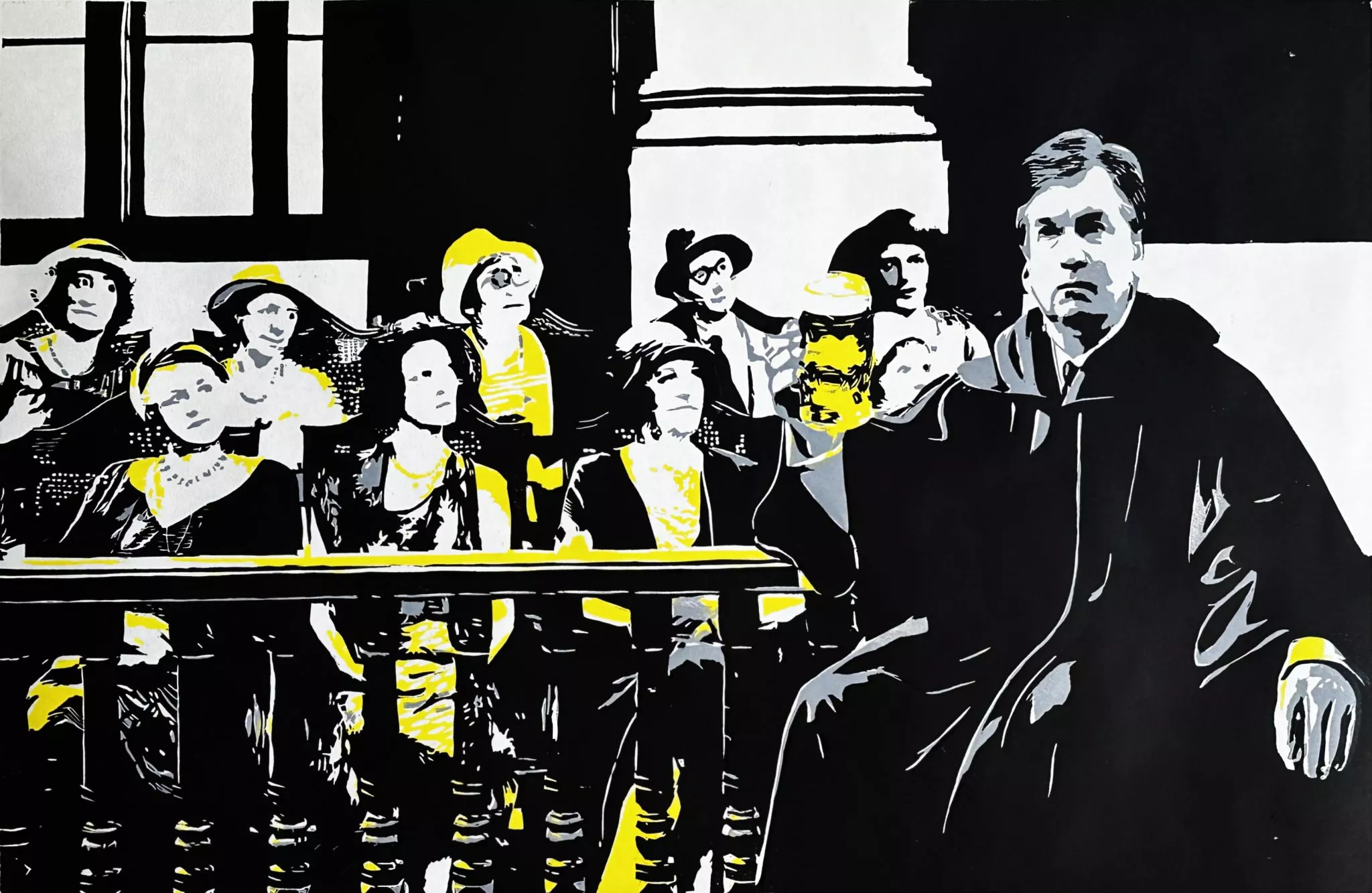
William Evertson's recently completed series of woodblock prints, SCOTUS 6, takes aim at the six conservative members of the United States Supreme Court: John Roberts, Clarence Thomas, Samuel Alito, Neil Gorsuch, Brett Kavanaugh, and Amy Coney Barrett. The prints in SCOTUS 6 continue Evertson's interest in asserting political activism through visual media. Using collaged imagery, Evertson blends appropriated historical art with contemporary references, creating familiar yet irreverent scenes packed with biting socio-political commentary.
Humorous yet contemplative, the prints in SCOTUS 6 raise serious questions about the integrity of the Court's decisions and its drastic reshaping of settled law. Recent cases decided by the Court's conservative majority have altered long-standing precedents including overturning Roe v. Wade, granting presidential immunity, restricting the government's ability to regulate, and loosening environmental laws. Evertson's prints waggishly critique the Court, sounding the alarm at a critical moment for the nation's future.
Born in 1952, Evertson grew up with drills hiding under desks in preparation for nuclear war – a precursor to today's active shooter drills. While a twenty-something artist, America's landscape of cultural and political upheaval - including the assassinations of Martin Luther King, Jr. and Robert F. Kennedy, anti-war protests, Black Panthers, the Chicago Seven, and Kent State Massacre – helped foment Evertson's passion for activist art.
The SCOTUS 6 series began with a stand-alone color woodblock print of Justice Clarence Thomas and his wife Ginni dancing amid the crumbling ruins of the Supreme Court Building. The Thomas' pose is copied from an illustration by Scottish artist John Faed depicting a raucous witches' Sabbath. Evertson wanted to emphasize the politization of the Court and the outside influences exacerbating the Justices' preexisting prejudices. Prints of Chief Justice John Roberts amid pinball machines representing cases in which the Court dismantled long standing rights and Samuel Alito chased by a witch borrowed from an Albrecht Dürer engraving followed soon after, as the project morphed into a series of works underlining the hypocrisy of the conservative Judges. Evertson recently finished the series with images of Neil Gorsuch performing at a drag queen story hour, Brett Kavanaugh proudly holding a stein of beer in front of an empaneled jury of suffragettes, and Amy Coney Barrett as Botticelli's Aphrodite surrounded by red robed Handmaids.
The exhibition will also include two prints by Evertson not part of the SCOTUS 6 series, but thematically related. Evertson's much lauded Capitol Offense 1814-2021 (included in the collections of several major institutions) blends imagery from the January 6th insurrection with an 1814 British wood engraving celebrating the burning of Washington DC and the Capitol building. Ketanji on the High Wire features the newest Justice and first Black woman to serve on the Supreme Court, Ketanji Brown Jackson, delicately balancing on a tightrope over a swamp of waiting crocodiles.
William Evertson: SCOTUS 6 is a provocative body of work in which each piece serves as a mirror reflecting the complexities of power and corruption in today's political arena. The exhibition is on view in the Childs Gallery print department October 4 through December 1, 2024. An opening reception with the artist will be held Saturday, October 5, 2-4pm.
Included Works


Robert S. Neuman: Under the Spanish Sun
Press Release:
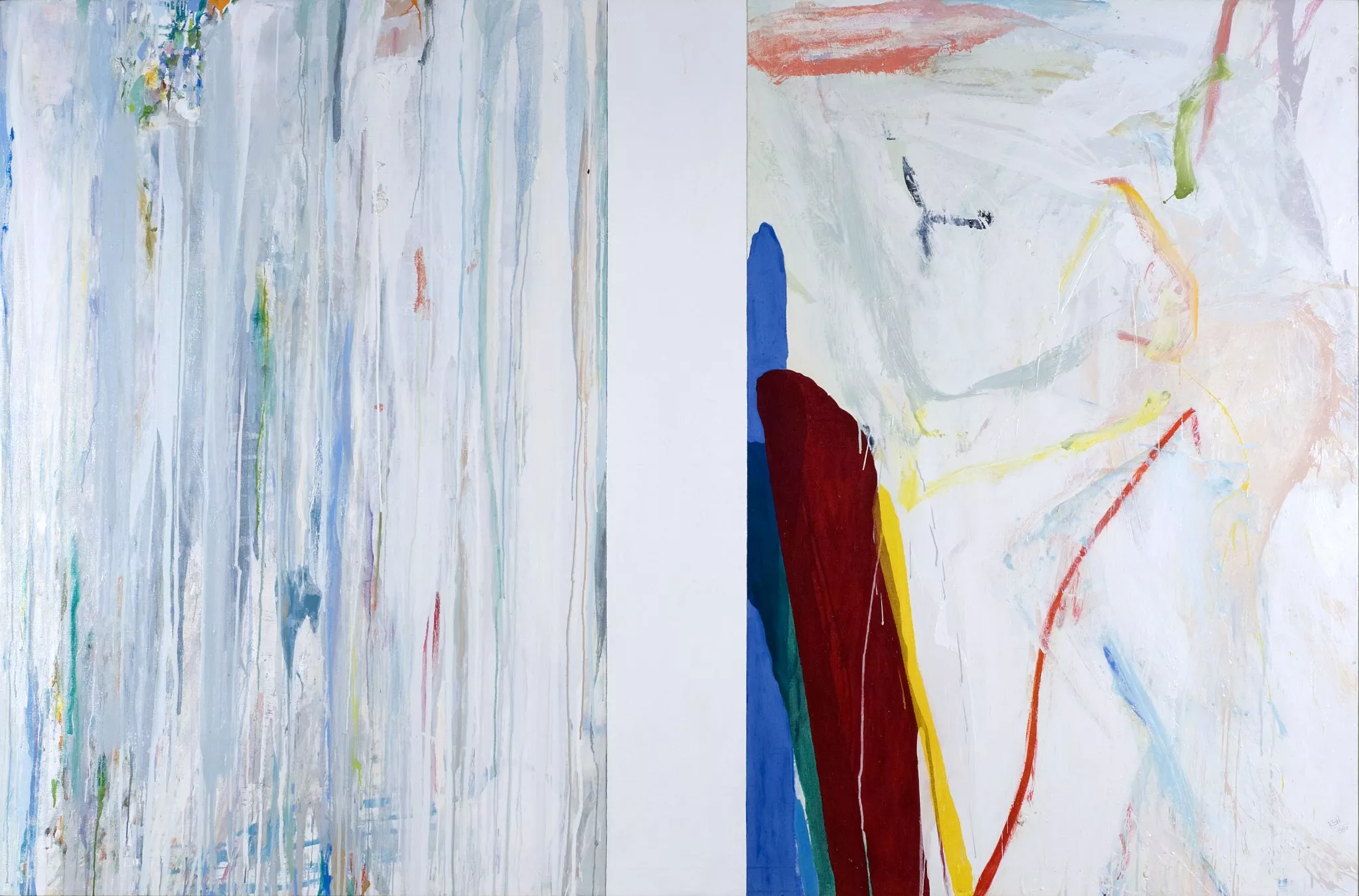
American abstract artist Robert S. Neuman first visited Spain on a Guggenheim Fellowship in 1956. The experience was profound for Neuman, prompting major stylistic changes, as well as inspiring a second visit for his honeymoon in the late 1970s. Robert S. Neuman: Under the Spanish Sun presents the artist's work from both sojourns and explores his distillation of Spanish culture onto canvas. Surveying these two distinctive yet innately related periods within the artist's oeuvre, the exhibition affirms Neuman's strong connection to Iberia – his fascination with Spain's inherent mysticism and spirituality translating into abstracted planes of color, form, and light.
Neuman's first trip to Spain found the artist centered in Barcelona, the northeastern capital of the autonomous community of Catalonia. There, Neuman was deeply moved by the particular atmosphere of the city, noting specifically that Barcelona's light projected dazzling effects onto other colors, even seemingly dull neutrals: "The light around Barcelona was very interesting. Any little thing seems to be very chromatic. I started painting with…these beautiful grays. I hadn't painted with gray before because I thought it was a neutral color, but the atmosphere and the light were such that even grays seemed to contain a great deal of color."
In the Barcelona paintings Neuman strove to capture this unusual effect of light, as well as the spiritual essence he felt implicitly tied to the country through its history of religious pluralism. Catholicism, Judaism, and Islam all thrived at different points in Spanish history though they were frequently violently at odds with one another. These paintings, such as Muro Catalano and (Untitled) Flag exhibit hues which deftly mimic the early dawn and dusk hours of northern Spain. The colors are pleasing, yet the paintings themselves hold within a buzzing energy reverberating from frenetic planes of black, which bisect the canvases. These strokes of inky darkness are perhaps Neuman's allusions to the country's turbulent history of zealotry, war, and persecution, or maybe a suggestion of the mysticism ingrained in such religious fervor, or both. They also reflect the influence of prominent Spanish artists such as Albert Ràfols-Casamada, Antoni Tàpies, and J.J. Tharrats, whose studios Neuman frequented at the time and notably used 'violent colors and huge brush strokes' in their paintings.
Neuman returned to Spain in the late 1970s, this time settling in Granada, the capital of Andalusia, for his honeymoon. Here, again, Neuman was taken with the perceived effects of light, this time observing its play within the intricate architecture of the Alhambra, a 13th century Moorish palace complex and home to the Nasrid dynasty before its fall to the Catholic monarchs Ferdinand II and Isabela I in 1492. Neuman was entranced by the palatine structure's famous colonnades which through slender columns produced broken bands of light, creating a repeating pattern of views and interruptions on the Alhambra's time-worn walls. From these rays of light, lines of seeing and not seeing, Neuman developed a specific reoccurring visual language for his Alhambra series – striations of color paired with columnar forms of white representing the palaces walls and pillars and the effects of sunlight on such architecture.
Many of the Alhambra paintings were produced after the artist's return to the United States, with the elements of time and physical distance cultivating interesting effects in the resultant works. These later pieces, such as Alhambra Drawing, see Neuman venturing further into abstraction than previous iterations in the series. The columns begin to shift, tilting as if demonstrating the passage of sunlight through the day, and cut across riotous backgrounds of bursting strokes and splotches of color. Neuman would continue to work within the series for years after his return, using his paintings, drawings, and studies to further explore Spain's rich atmosphere and history through an increasingly abstracted Alhambra vernacular.
In Spain Neuman found inspiration to examine, breakdown, and rethink the major elements of his paintings: color, light, and composition. Though not a religious man himself, the artist's time in Barcelona and Granada was tantamount to an artistic spiritual experience, allowing Neuman to encapsulate the soul of a country through his abstracted vision of its distinctive culture and history.
Robert S. Neuman: Under the Spanish Sun is on view September 20 through November 17, 2024. An opening reception will be held Friday, September 20, 6-8pm.


Musical Interlude: An Online Exhibition
Press Release:
Musical Interlude is an exhibition highlighting artwork inspired by music. The harmonies and rhythms found in music can spark creativity, evoke vivid imagery, and elicit emotions that visual artists can draw from in their work. Melodies become colors on canvas or shapes in clay. Enjoy a multi-sensory experience as you browse through the featured paintings, prints, and sculptures.
Included Works


Surreal Spaces
Press Release:
Surreal Spaces explores fantastical interiors and exteriors dreamed up by some of today's most imaginative printmakers. Featuring works by artists including David Avery, Erik Desmazières, Annemarie Petri, and Gerard Trignac, among others, the exhibition presents images both dreamlike and nightmarish – bizarre visions drawing the eye and mind into intricately beautiful new worlds.
Surreal Spaces celebrates 'Art Fantastique,' a broad genre not restricted to any specific time, location, or school, but rather characterized by non-realistic subject matter portrayed in a representational and naturalistic style. Though loosely defined, it has been an integral part of many other art movements including Mannerism, Romanticism, Symbolism, Magic Realism, and, of course, Surrealism.
The works in Surreal Spaces depict futuristic cities, ancient ruins, peaceful gardens, and cluttered interiors with complex detailing and baroque flourishes that impart a sensibility, and even familiarity, into images of places and times that have never existed in our world but are rooted in our knowledge and understanding of it. Taking cues from history, mythology, science fiction, and fantasy, the works represent artistic worldbuilding at its best; each piece is a cosmos unto itself, a lived in reality of some other people or civilization. Highlights include Annemarie Petri's monoprint etchings of starkly ethereal cities that seem to exist between dimensions, fading in and out perception; Gerard Trignac's L'Embarquement pour Cythère, a dark and haunting play on Jean-Antoine Watteau's famous Rococo 'fête galante;' David Avery's The Anatomy of Melancholy, in which macabre marginalia explode across a windswept room; and Erik Desmazières' cerebral Passage du Caire, a twisted, serpentine reimagining of Paris' oldest covered arcade.
Surreal Spaces is on view in Childs Gallery's upstairs print department August 9 through September 29, 2024.


Jason Berger: American Fauve
Press Release:
Jason Berger: American Fauve traces the artistic lineage of Jason Berger (1924-2010), drawing connections between the Boston Expressionist painter and his Fauvist antecedents. Known for his exuberant landscapes and joyful outlook on life, Berger's use of vibrant, saturated colors and expressive brushwork place him firmly within the legacy of Fauvism.
Led by Henri Matisse (1869-1954) and André Derain (1880-1954), Fauvism was an early 20th Century art movement concerned with the expressive potency of color. Working together in the south of France in 1905, Matisse and Derain introduced highly saturated colors and bold, undisguised brushwork into their paintings, favoring simplification and abstraction over naturalistic representation. The paintings caused a sensation when they were exhibited at the Salon d'Automne in Paris later that year. Initially ridiculed for their bold coloration and seemingly wild paint application, art critic Louis Vauxcelles dubbed the group Les Fauves, or "the wild beasts".
Following his graduation from Boston's School of the Museum of Fine Arts in 1949, Berger was awarded the school's European Traveling Fellowship and departed for France. He eagerly absorbed the work of the Fauves and other French modernists; "It was a significant time to go to Europe since Bonnard, Matisse, Dufy, Picasso, and Braque were all still living there and showing their work." In 1952, after viewing an exhibition of Matisse's cut-outs at the Maison de la Pensée, Berger was fortunate enough to run into the aging artist at a nearby café.
By the early 1950s, Berger had thoroughly fallen under the influence of the Fauves. Gone was the dark, moody palette of Boston Expressionism, which he had previously embraced – and in its place, a riot of pure color. Paintings such as Hotel Lobby, Patzcuaro, 1972/74 bring to mind Matisse's Fauvist icon Open Window, Collioure, 1905. Both compositions are sited on the threshold, interior scenes unfolding upon views of the natural world. Like Matisse, Berger employs a maximum intensity of color, relying on broad areas of complementary hues to create contrast and spatial depth. Expressive color, line, and brushwork activate both compositions, drawing the viewer into the space. For Berger, just as Matisse, the open window or doorway became a central motif in the artist's oeuvre.
Jason Berger: American Fauve celebrates Berger's Fauvist palette, bringing together outstanding examples of the artist's landscapes and studio paintings. Fauvism offered Berger a visual language to express his unique joie de vivre, allowing his paintings to blossom with vibrant pigments and a sense of joyful spontaneity.
The exhibition is on view in our main gallery space through September 15, 2024.
Included Works


![Watercolor by Jason Berger: [Seated Woman], available at Childs Gallery, Boston](https://childsgallery.com/wp-content/uploads/jason-berger_seated-woman_23-08-359_childs_gallery_47513-750x750.webp)


Jolis Dessins: 19th Century French Drawings – An Online Exhibition
Press Release:
19th-century France saw the art of drawing transformed. Though initially draftsmanship was taught as a means of artistic training, the medium was reinvented as an independent form of expression rife with potential for exploration in materials and subject matter. During this time, venues began to exhibit drawings with the same reverence as paintings and sculpture, and collecting these artworks became fashionable amongst both museums and private individuals.
Jolis Dessins presents a group of 19th century French drawings by both known and unknown artists, with subjects ranging from deftly rendered portraiture to architectural studies both real and fantastical. The exhibition displays the virtuosity of French artists experimenting with a medium in rebirth. Jolis Dessins is available to view online through July 31, 2024.
Included Works


![Drawing by French School: [Reconstructed view of ancient seaport, probably Alexandria], represented by Childs Gallery](https://childsgallery.com/wp-content/uploads/french_school__reconstructed_view_of_ancient_cgl23236-3-46_childs_gallery-2-250x250.webp)


![Drawing by Circle of Jacques-Louis David: [Building in a Landscape], represented by Childs Gallery](https://childsgallery.com/wp-content/uploads/circle_of_jacques-louis_david_building_in_a_landscape__p1417-11_childs_gallery-1.webp)
